PID and degradation testing
Tell normal ageing from damage that can be reversed. Potential induced degradation (PID) builds up when modules sit at high voltage relative to ground. We look for its signature in IV curves and EL images, and measure how fast modules are ageing compared with their warranty curve.
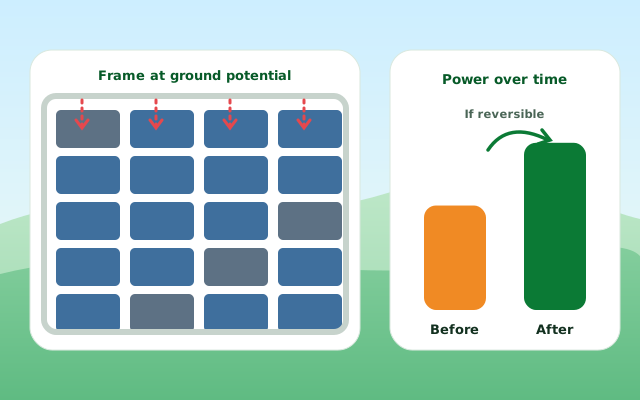
- Modules at the negative end of strings are weaker
- Output has fallen faster than the warranty curve
- You are considering a PID recovery device
- A buyer or lender asks for degradation numbers
- Avoids paying for a remedy when the loss is something else
- Gives a defensible degradation figure
- Helps plan module replacement or claims
How we do it, step by step.
Look for voltage-position patterns in string performance.
Use IV curves and EL images on selected modules.
Compare measured power with the manufacturer's degradation guarantee.
Explain whether reversal or replacement is worth considering.
- A view of how much of the loss is PID and how much is normal ageing
- Evidence for a warranty discussion
- Re-test after any recovery action to see whether it worked
Outcomes depend on what the inspection finds. Possibilities are labelled as such in every report.
- Degradation estimate by sample
- Before and after comparison where a remedy is tried
- Recommendation note
Instruments: IV tracer, EL camera, reference cell
Reversing potential induced degradation at a Gujarat plant
Separately, stricter O&M practices at the same plant added an average power gain of about 2%.
Read the case →Other services
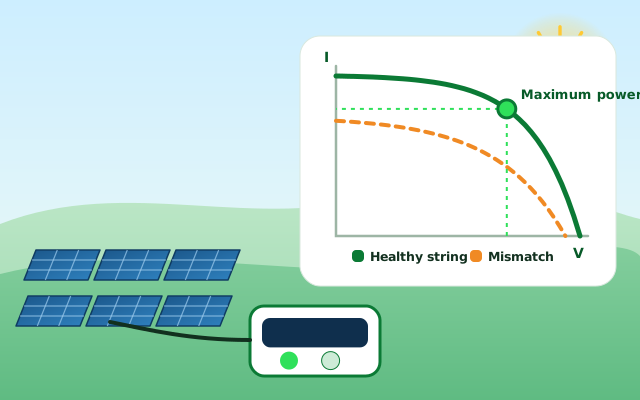
IV curve tracing
Measure what each string and module can really deliver.
See the process and outcomes →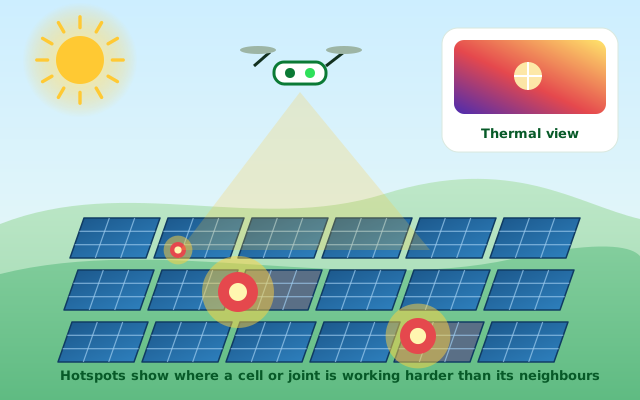
Thermography
See heat problems from the ground or from the air.
See the process and outcomes →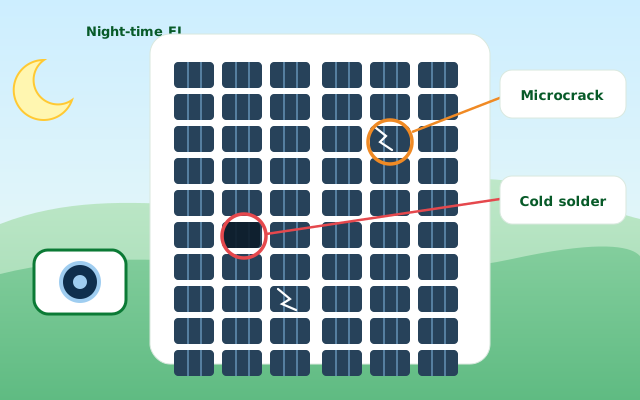
Electroluminescence (EL) imaging
Look inside cells for cracks and bad solder joints.
See the process and outcomes →Want this test on your plant?
Send an enquiry and we will prepare a checklist for your site.